Bild 1 von 2
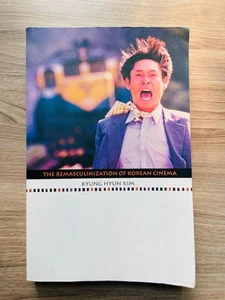

Galerie
Bild 1 von 2


The Remasculinizat

US $19,00
Ca.EUR 16,38
Artikelzustand:
- Sofort-KaufenThe Remasculinization of Korean Cinema by Kyung Hyun Kim: Used
Oops! Looks like we're having trouble connecting to our server.
Refresh your browser window to try again.
Versand:
US $5,22 (ca. EUR 4,50) USPS Media MailTM.
Standort: Arlington, Virginia, USA
Lieferung:
Lieferung zwischen Do, 4. Dez und Di, 9. Dez nach 94104 bei heutigem Zahlungseingang
Rücknahme:
Keine Rücknahme.
Zahlungen:
Sicher einkaufen
- Gratis Rückversand im Inland
- Punkte für jeden Kauf und Verkauf
- Exklusive Plus-Deals
Info zum Artikel
Der Verkäufer ist für dieses Angebot verantwortlich.
eBay-Artikelnr.:177152274157
Artikelmerkmale
- Artikelzustand
- Pages
- 331
- Publication Date
- 2004-03-08
- ISBN
- 9780822332671
Über dieses Produkt
Product Identifiers
Publisher
Duke University Press
ISBN-10
0822332671
ISBN-13
9780822332671
eBay Product ID (ePID)
30440229
Product Key Features
Book Title
Remasculinization of Korean Cinema
Number of Pages
344 Pages
Language
English
Topic
Film / General, Men's Studies, Asia / General
Publication Year
2004
Illustrator
Yes
Genre
Performing Arts, Social Science, History
Book Series
Asia-Pacific: Culture, Politics, and Society Ser.
Format
Trade Paperback
Dimensions
Item Height
1 in
Item Weight
17.5 Oz
Item Length
9.2 in
Item Width
6 in
Additional Product Features
Intended Audience
Trade
LCCN
2003-016644
TitleLeading
The
Reviews
"This is an important book. There is a long tradition of scholarship investigating the representation of women in Asian cinema. This has included some consideration of Korean film, which more often than not finds the representations of Korean women wanting in one way or another. It took Kyung Hyun Kim's writing to turn my attention to the rich complexity of the men. His focus on masculinity--coinciding with the turn to the issue by major feminist film theorists--simply makes perfect sense. His is a particularly compelling contribution to the study of Asian cinema, but is simultaneously in dialogue with all manner of gender studies."--Abé Mark Nornes, University of Michigan, "Kyung Hyun Kim's book is a roller coaster ride through modern South Korean masculinity in the cinema. At once unflinching and sympathetic, Kim's groundbreaking study traces Korean permutations on the gendered imagery of castration and rape and the impossible condition of postcolonial masculinity, caught between incommensurable values and demands."--Chris Berry, coeditor of Mobile Cultures: New Media in Queer Asia "This is an important book. There is a long tradition of scholarship investigating the representation of women in Asian cinema. This has included some consideration of Korean film, which more often than not finds the representations of Korean women wanting in one way or another. It took Kyung Hyun Kim's writing to turn my attention to the rich complexity of the men. His focus on masculinity--coinciding with the turn to the issue by major feminist film theorists--simply makes perfect sense. His is a particularly compelling contribution to the study of Asian cinema, but is simultaneously in dialogue with all manner of gender studies."--Abé Mark Nornes, University of Michigan, "This is an important book. There is a long tradition of scholarship investigating the representation of women in Asian cinema. This has included some consideration of Korean film, which more often than not finds the representations of Korean women wanting in one way or another. It took Kyung Hyun Kim's writing to turn my attention to the rich complexity of the men. His focus on masculinity--coinciding with the turn to the issue by major feminist film theorists--simply makes perfect sense. His is a particularly compelling contribution to the study of Asian cinema, but is simultaneously in dialogue with all manner of gender studies."--Ab Mark Nornes, University of Michigan, "Kyung Hyun Kim's book is a roller coaster ride through modern South Korean masculinity in the cinema. At once unflinching and sympathetic, Kim's groundbreaking study traces Korean permutations on the gendered imagery of castration and rape and the impossible condition of postcolonial masculinity, caught between incommensurable values and demands."-Chris Berry, coeditor of Mobile Cultures: New Media in Queer Asia, "This is an important book. There is a long tradition of scholarship investigating the representation of women in Asian cinema. This has included some consideration of Korean film, which more often than not finds the representations of Korean women wanting in one way or another. It took Kyung Hyun Kim's writing to turn my attention to the rich complexity of the men. His focus on masculinity-coinciding with the turn to the issue by major feminist film theorists-simply makes perfect sense. His is a particularly compelling contribution to the study of Asian cinema, but is simultaneously in dialogue with all manner of gender studies."-Abé Mark Nornes, University of Michigan, "Kyung Hyun Kim's book is a roller coaster ride through modern South Korean masculinity in the cinema. At once unflinching and sympathetic, Kim's groundbreaking study traces Korean permutations on the gendered imagery of castration and rape and the impossible condition of postcolonial masculinity, caught between incommensurable values and demands."--Chris Berry, coeditor of Mobile Cultures: New Media in Queer Asia "This is an important book. There is a long tradition of scholarship investigating the representation of women in Asian cinema. This has included some consideration of Korean film, which more often than not finds the representations of Korean women wanting in one way or another. It took Kyung Hyun Kim's writing to turn my attention to the rich complexity of the men. His focus on masculinity--coinciding with the turn to the issue by major feminist film theorists--simply makes perfect sense. His is a particularly compelling contribution to the study of Asian cinema, but is simultaneously in dialogue with all manner of gender studies."--Ab Mark Nornes, University of Michigan, “Kyung Hyun Kim’s book is a roller coaster ride through modern South Korean masculinity in the cinema. At once unflinching and sympathetic, Kim’s groundbreaking study traces Korean permutations on the gendered imagery of castration and rape and the impossible condition of postcolonial masculinity, caught between incommensurable values and demands.â€�-Chris Berry, coeditor of Mobile Cultures: New Media in Queer Asia, "Kyung Hyun Kim's book is a roller coaster ride through modern South Korean masculinity in the cinema. At once unflinching and sympathetic, Kim's groundbreaking study traces Korean permutations on the gendered imagery of castration and rape and the impossible condition of postcolonial masculinity, caught between incommensurable values and demands."-Chris Berry, coeditor ofMobile Cultures: New Media in Queer Asia"This is an important book. There is a long tradition of scholarship investigating the representation of women in Asian cinema. This has included some consideration of Korean film, which more often than not finds the representations of Korean women wanting in one way or another. It took Kyung Hyun Kim's writing to turn my attention to the rich complexity of the men. His focus on masculinity-coinciding with the turn to the issue by major feminist film theorists-simply makes perfect sense. His is a particularly compelling contribution to the study of Asian cinema, but is simultaneously in dialogue with all manner of gender studies."-Abé Mark Nornes, University of Michigan, "Kyung Hyun Kim's book is a roller coaster ride through modern South Korean masculinity in the cinema. At once unflinching and sympathetic, Kim's groundbreaking study traces Korean permutations on the gendered imagery of castration and rape and the impossible condition of postcolonial masculinity, caught between incommensurable values and demands."--Chris Berry, coeditor of Mobile Cultures: New Media in Queer Asia
Dewey Edition
22
Dewey Decimal
791.4365211
Table Of Content
Acknowledgments ix Introduction: Hunting for the Whale 1 1: GENRES OF POST-TRAUMA At the Edge of Metropolis in A Fine, Windy Day and Green Fish 31 2 Nowhere to Run: Disenfranchised Men on the Road in The Man with Three Coffins , Sopyonje , and Out to the World 52 3 "Is This How the War Is Remembered?": Violent Sex and the Korean War in Silver Stallion , Spring in My Hometown , and The Taebaek Mountains 77 4 Post-Trauma and Historical Remembrance in A Single Spark and A Petal 107 2: NEW KOREAN CINEMA AUTEURS 5 Male Crisis in the Early Films of Park Kwang-su 136 6 Jang Sun-woo's Three "F" Words: Familism, Fetishism, and Fascism 162 7 Too Early/Too Late: Temporality and Repetition in Hong Sang-su's Films 203 3: FIN-DE-SIECLE ANXIETIES 8 Lethal Work: Domestic Space and Gender Troubles in Happy End and The Housemaid 233 9 "Each Man Kills the Thing He Loves": Transgressive Agents, National Security, and Blockbuster Aesthetics in Shiri and Joint Security Area 259 Notes 277 Select Filmography of Major Directors of the New Korean Cinema 313 Index 321
Synopsis
In one of the first English-language studies of Korean cinema to date, Kyung Hyun Kim shows how the New Korean Cinema of the past quarter century has used the trope of masculinity to mirror the profound sociopolitical changes in the country. Since 1980, South Korea has transformed from an insular, authoritarian culture into a democratic and cosmopolitan society. The transition has fueled anxiety about male identity, and amid this tension, empowerment has been imagined as remasculinization. Kim argues that the brutality and violence ubiquitous in many Korean films is symptomatic of Korea's on-going quest for modernity and a post-authoritarian identity. Kim offers in-depth examinations of more than a dozen of the most representative films produced in Korea since 1980. In the process, he draws on the theories of Jacques Lacan, Slavoj Zizek, Gilles Deleuze, Rey Chow, and Kaja Silverman to follow the historical trajectory of screen representations of Korean men from self-loathing beings who desire to be controlled to subjects who are not only self-sufficient but also capable of destroying others. He discusses a range of movies from art-house films including To the Starry Island (1993) and The Day a Pig Fell into the Well (1996) to higher-grossing, popular films like Whale Hunting (1984) and Shiri (1999). He considers the work of several Korean auteurs--Park Kwang-su, Jang Sun-woo, and Hong Sang-su. Kim argues that Korean cinema must begin to imagine gender relations that defy the contradictions of sexual repression in order to move beyond such binary struggles as those between the traditional and the modern, or the traumatic and the post-traumatic., Argues that although the last two decades of Korean history were a period of progress in political democratization, the country refused to part from a "masculine point of view" which is also mirrored in Korean cinema., In one of the first English-language studies of Korean cinema to date, Kyung Hyun Kim shows how the New Korean Cinema of the past two decades has used the trope of masculinity to mirror the profound socio-political changes underway in Korea. Since 1980, the country has transformed from an insular, authoritarian culture into a democratic and cosmopolitan society. The transition has fueled anxiety about male identity and, as Kim shows, amid this tension, empowerment has been imagined as remasculinization. He argues that the brutality and violence ubiquitous in many Korean films is symptomatic of Korea's ongoing quest for modernity and a post-authoritarian identity.Kim offers in-depth examinations of more than a dozen of the most representative films produced in Korea between roughly 1980 and 2001. In the process, he draws on the theories of Jacques Lacan, Slavoj Zizek, Gilles Deleuze, Rey Chow, and Kaja Silverman to follow the historical trajectory of screen representations of Korean men from self-loathing beings who desire to be controlled to self-sufficient subjects capable of destroying others. He discusses a range of movies from arthouse films includingTo the Starry Island(1993) andThe Day a Pig Fell into the Well(1996) to higher-grossing, popular films likeWhale Hunting(1984) andShiri(1999). He considers the work of several Koreanauteurs-Park Kwang-su, Jung Sun-woo, and Hong Sang-su. Kim argues that Korean cinema must begin to imagine gender relations that defy the contradictions of sexual repression in order to move beyond such binary struggles as those between the traditional and the modern or the traumatic and the post-traumatic.
LC Classification Number
PN1993
Artikelbeschreibung des Verkäufers
Info zu diesem Verkäufer

Toyraiderdc
98,6% positive Bewertungen•12.709 Artikel verkauft
Angemeldet als privater VerkäuferDaher finden verbraucherschützende Vorschriften, die sich aus dem EU-Verbraucherrecht ergeben, keine Anwendung. Der eBay-Käuferschutz gilt dennoch für die meisten Käufe. Mehr erfahrenMehr erfahren
Verkäuferbewertungen (5.150)
- e***- (27)- Bewertung vom Käufer.Letzte 6 MonateBestätigter KaufHonestly I was worried. It took almost a week from the time the order was purchased until the item actually shipped. I had to pester the seller several times to see what was up. Their page says items are shipped within 3 days of purchase, not a week. However the item was delivered within the original windows. I got a screaming deal on the item, packaging was adequate and everything was exactly as described.
- r***j (31)- Bewertung vom Käufer.Letzte 6 MonateBestätigter KaufShipping was reasonable, item was well packaged and as described. Excellent communication and great value! Well done and thank you!
- 0***- (1043)- Bewertung vom Käufer.Letzte 6 MonateBestätigter KaufI love this 1950s Christmas Magazine. Looking back in time, love seeing the MCM home decor and it also has some fashion in it. In great condition and as described. Packed very good and shipped out fast. Great communication Excellent seller A+ Thank you.
Noch mehr entdecken:
- Kim Harrison Belletristik-Bücher,
- Masters of the Universe Jugendliche Hörbücher und Hörspiele,
- Erwachsene Masters of the Universe Hörbücher und Hörspiele,
- Masters of the Universe Jugendliche Hörbücher und Hörspiele,
- Erwachsene Masters of the Universe Hörbücher und Hörspiele,
- Ungekürzte Masters of the Universe Buchreihe Hörbücher und Hörspiele,
- Masters of the Universe Buchreihe Hörbücher und Hörspiele mit Kinder- & Jugendliteratur,
- Masters of the Universe Buchreihe Hörbücher und Hörspiele mit Kinder- & Jugendliteratur,
- Shades-of-Grey-Belletristik - Bücher,
- Frederick-the-Great-Belletristik - Bücher
Toyraiderdc
98,6% positive Bewertungen•12.709 Artikel verkauft
Angemeldet als privater VerkäuferDaher finden verbraucherschützende Vorschriften, die sich aus dem EU-Verbraucherrecht ergeben, keine Anwendung. Der eBay-Käuferschutz gilt dennoch für die meisten Käufe. Mehr erfahrenMehr erfahren
Verkäuferbewertungen (5.150)
- e***- (27)- Bewertung vom Käufer.Letzte 6 MonateBestätigter KaufHonestly I was worried. It took almost a week from the time the order was purchased until the item actually shipped. I had to pester the seller several times to see what was up. Their page says items are shipped within 3 days of purchase, not a week. However the item was delivered within the original windows. I got a screaming deal on the item, packaging was adequate and everything was exactly as described.
- r***j (31)- Bewertung vom Käufer.Letzte 6 MonateBestätigter KaufShipping was reasonable, item was well packaged and as described. Excellent communication and great value! Well done and thank you!
- 0***- (1043)- Bewertung vom Käufer.Letzte 6 MonateBestätigter KaufI love this 1950s Christmas Magazine. Looking back in time, love seeing the MCM home decor and it also has some fashion in it. In great condition and as described. Packed very good and shipped out fast. Great communication Excellent seller A+ Thank you.